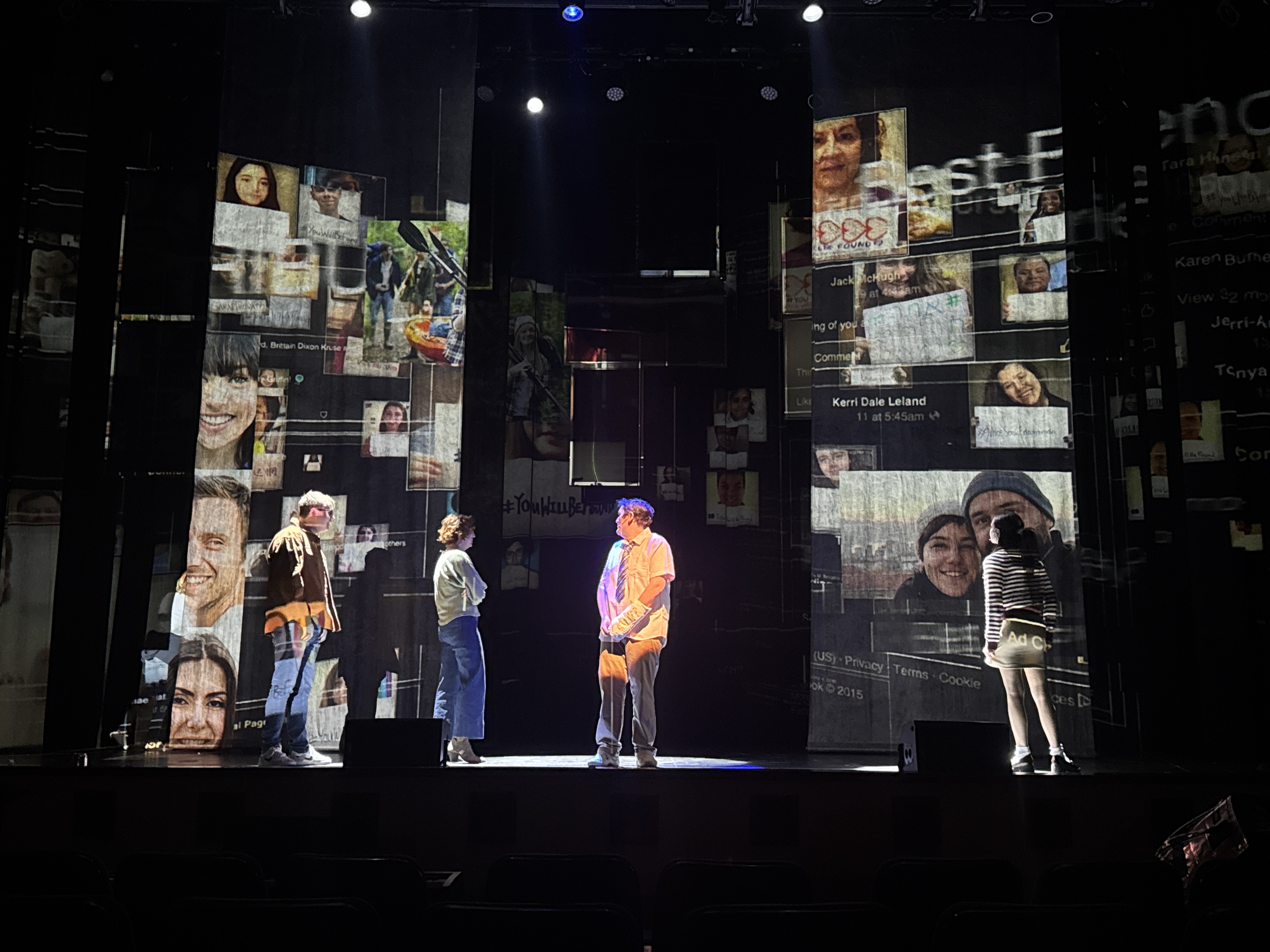
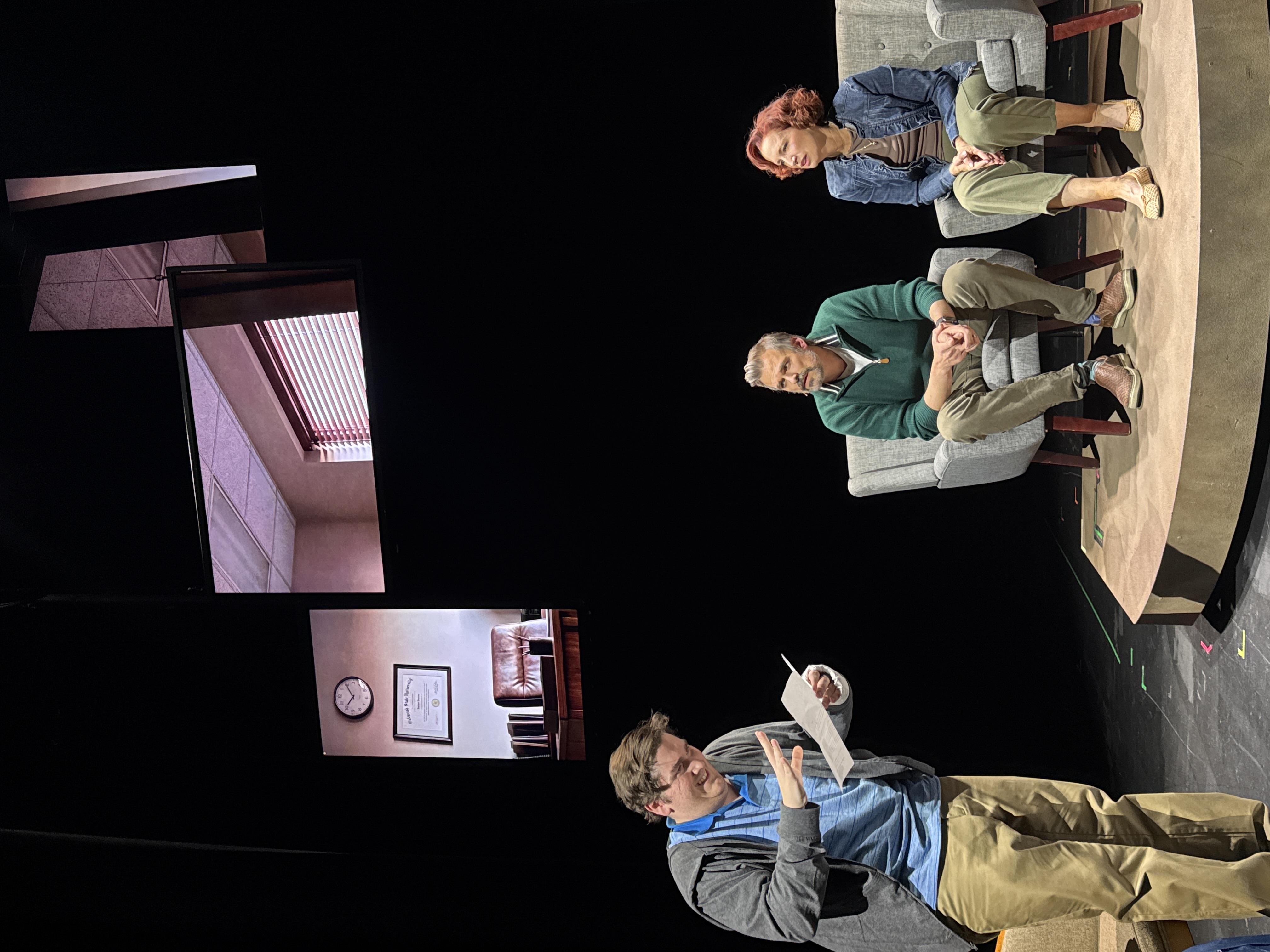
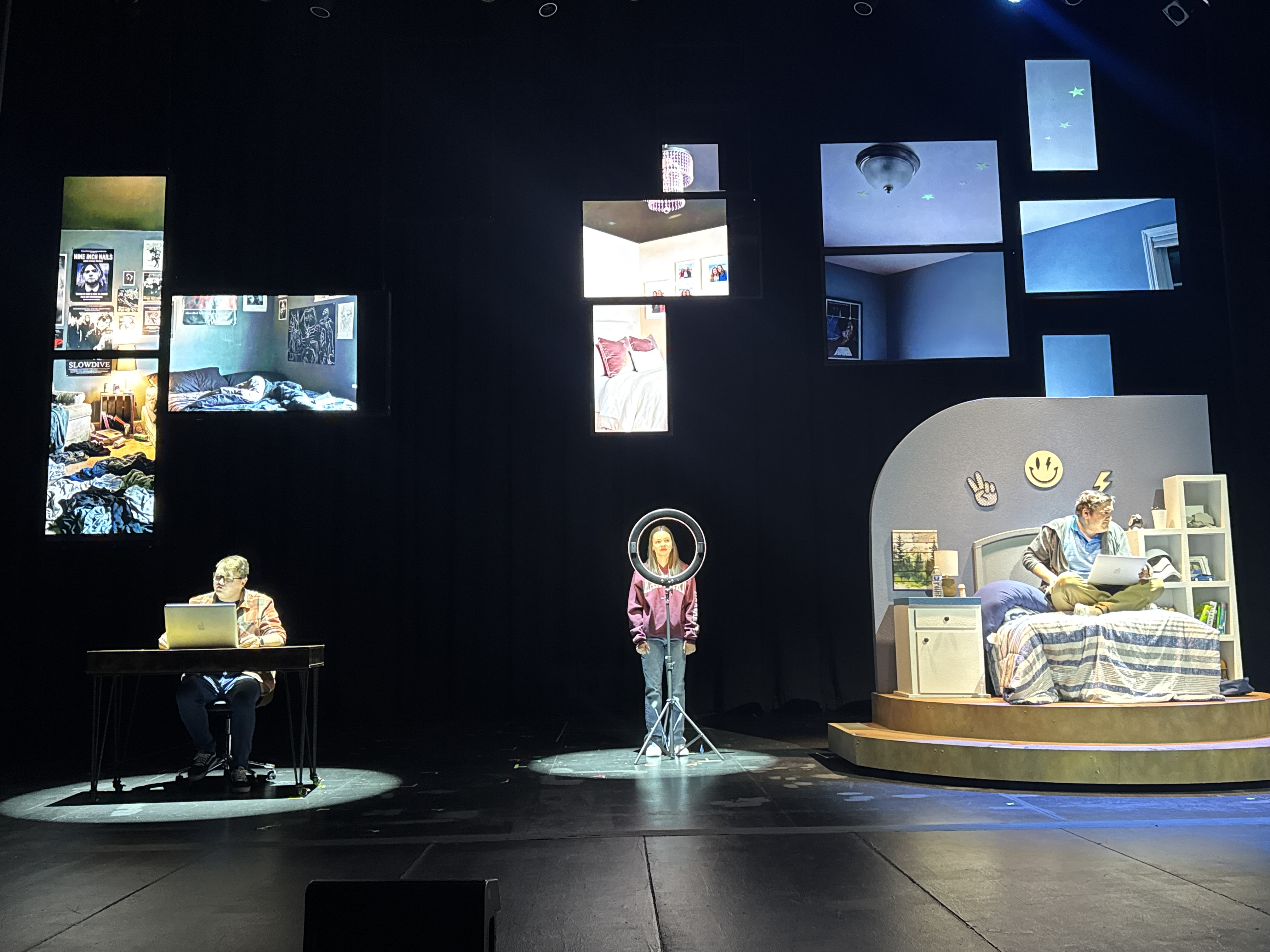
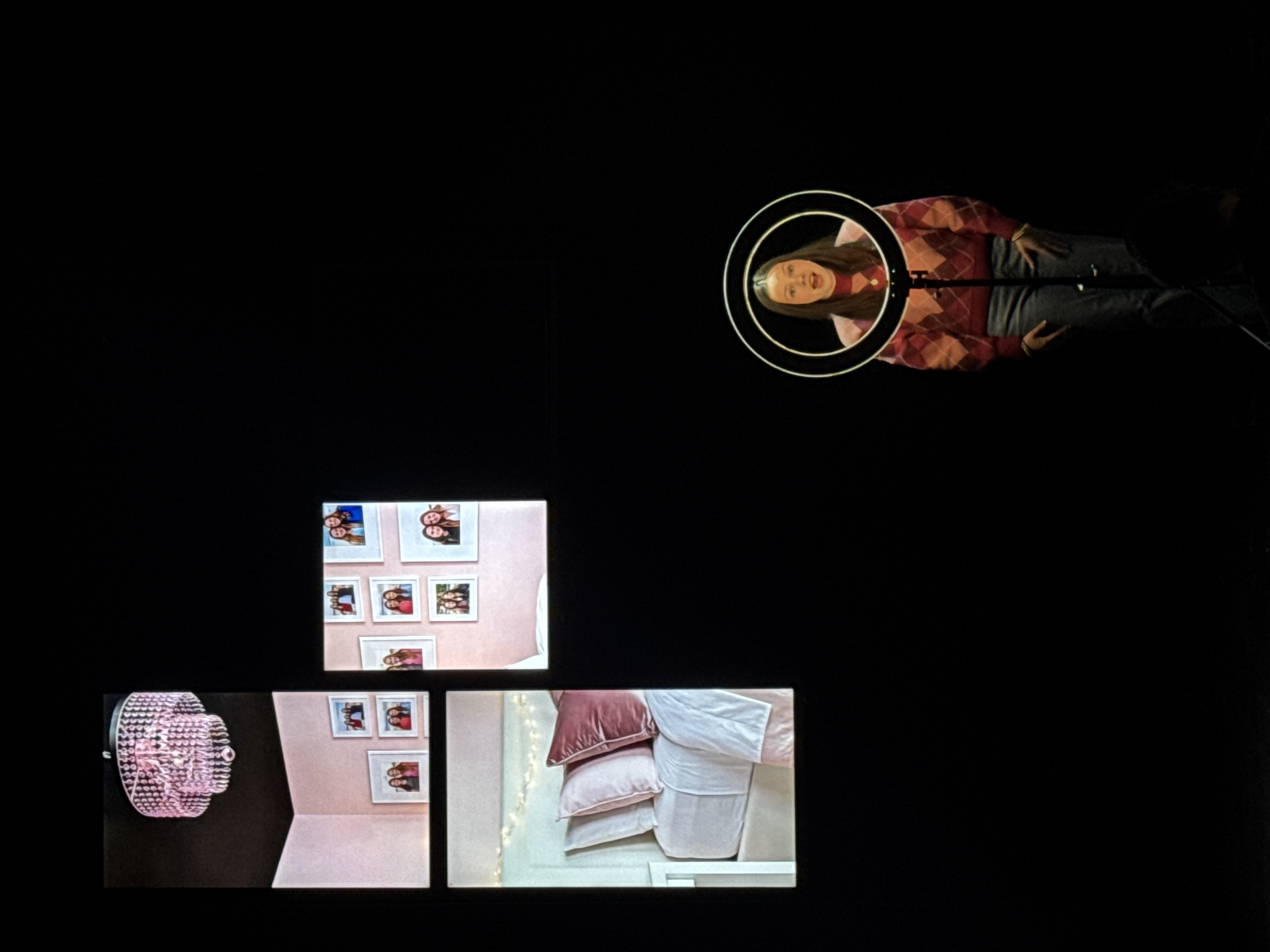
The original Broadway production of Dear Evan Hansen made a choice that changed the grammar of modern musical theatre: it put social media onstage. Peter Nigrini's projection design at the Music Box Theatre rendered the external world amplified — text messages, notifications, viral videos, the cascading faces of strangers who turn a teenage lie into a movement. It worked because it was honest about what isolation looks like in the digital age. And it established a vocabulary that virtually every subsequent production has either imitated or reacted against.
BSC's Nevada premiere, projection designed by Jeff Tidwell, makes a harder choice. It doesn't show you the internet. It shows you what the internet feels like from the inside.
The Inversion: Exteriority to Interiority
Tidwell's design operates on a fundamentally different principle than Nigrini's original. Where the Broadway production used projected images to show the audience what was happening in the external world — the viral spread, the social media cascades, the public amplification of Evan's lie — Tidwell renders interiority. His visual grammar is fragmentation: memory as it actually feels, unreliable and layered. The screen isn't a window to the outside world. It's a window into Evan's head.
This is a significant interpretive shift, and it's worth understanding why it matters from a craft perspective. The original design made the audience complicit — you watched the lie spread in real time and felt the vertigo of viral amplification. Tidwell's design makes the audience intimate — you experience the lie's weight from inside the mind that created it. These are different dramaturgical arguments, and they produce different emotional responses.
"The projection isn't decoration. It's the play's nervous system — ambient, intrusive, beautiful, and damning all at once."
The Held Image: "Words Fail" and the Power of Stillness
The craft note worth making for anyone building this kind of work: Tidwell's design achieves its most powerful moments by going still. In a form where projection is tempted toward constant motion — because motion is attention, because audiences have been trained to track movement — the held images in "Words Fail" create a silence that the orchestra cannot.
This is what distinguishes a projection designer from a projection operator. The former makes aesthetic and dramaturgical decisions about what light means. The latter executes a cue sheet. Tidwell is clearly the former: every image choice reads as an argument about the character, not an illustration of the script. His 40 years of professional design experience show precisely in knowing when not to move.
Jeremy Jones: Lighting as Collaborative Infrastructure
Jeremy Jones' lighting design is the essential partner to Tidwell's projections. Jones — who began his career at this same Summerlin venue in 1996, went on to install Cirque du Soleil's O at Bellagio, and ran the Miss Saigon National Tour — brings a professional infrastructure to a community production that reshapes what the room can do.
The collaboration between projection and lighting is where most productions fail, even professional ones. Projection needs darkness to read; lighting needs visibility for performers. These demands are in structural tension. Jones resolves the tension by treating his cues as support for Tidwell's design concept rather than competing with it. The color choices are complementary, the transitions are synchronized, and the emotional register of the lighting matches the production's overall commitment to intimacy over spectacle.
This is the kind of design integration you see in well-resourced regional productions and almost never in community theatre. It's evidence that when your designers share a vision and communicate during the process — not just in tech week — the result is qualitatively different.
The Direction and Performances in Context
Director Jen Hemme's overarching choice — intimacy over scale — is what makes the design integration possible. The staging doesn't fight the projections or the lighting. Everything is pulling in the same direction. Choreographer Rachel Debenedetto and intimacy choreographer Lillian Brown extend this logic into the physical work.
Gus Pappas (Evan Hansen) inhabits the role's anxiety rather than performing it — a distinction that matters enormously for Tidwell's inward-facing design, because the projections need a performer who is genuinely occupying internal space, not signaling it. Shannon Payette Seip (Cynthia Murphy) — Off-Broadway, Come From Away Western Australia — provides the professional anchor. Mary Engelhardt (Heidi Hansen) carries the emotional demands of the second act. Tristen Serpa (Connor, Boston Conservatory at Berklee), Emma Phillips (Zoe), Brandon Albright (Larry), Trevor Rounds (Jared), and Khloe Judd (Alana, 17, Las Vegas Academy) all serve the production's register.
Holly Stanfield's music direction (Stephen Schwartz's 2021 Musical Theatre Teacher of the Year) keeps the pit in the same emotional lane as the design — supporting the performers without overwhelming the visual work.
What This Production Teaches
The lesson of BSC's Dear Evan Hansen isn't that community theatre can compete with Broadway. It's that when a production makes a clear interpretive choice at the design level and commits to it across every department, the result is a coherent theatrical experience regardless of the producing context. The choice Tidwell and Jones have made — interiority over exteriority, stillness over spectacle — is a legitimate artistic argument, and it's one that this room, this company, and these performers can deliver.
That's the craft note worth keeping.
Production Credits
* Projection design: Jeff Tidwell. Original Broadway projection designs licensed through Broadway Media; additional original designs created by Jeff Tidwell for this production. The approach pays homage to the original Broadway production while bringing a fresh, more modern sensibility to this staging.
Broadway Stage Collective
Summerlin Library and Performing Arts Center · 1771 Inner Circle Drive, Las Vegas, NV 89134
Schedule: Thu–Fri 7:30pm · Sat 2pm & 7:30pm · Sun 2pm · Special Mon Apr 13 7:30pm
April 2: Moderated Language Performance
Through April 19, 2026
Tickets: dearevanhansen.vegas · 844-228-9849 · inquiry@givingnotes.com
Content advisory: Teen suicide, mental health, substance use. Rated PG-13 (MTI). Hope Means Nevada (hopemeansnevada.org) representatives at select performances. Crisis line: 988.